I Hit Coast FI at 34 — And I Did It By Accident
The most boring financial decision I made at 22 turned into something I didn't even have a name for until I was 34.
I'm a full-time working mom with a corporate job, two toddlers, a husband, and a mortgage that makes my stomach hurt a little every month. I don't think of myself as someone who "has it figured out." But a few months ago I ran a number and found out that I never technically have to save for retirement again.
Here's what happened — and what I'm actually doing with that information.
The Boring Thing I Did at 22
When I was interning in college, during onboarding the company walked us through how to set up our 401k. They told us: contribute 5% and we'll match it 5%.
So I did. I set it up, forgot about it, and moved on with my life.
That's it. No spreadsheets. No Roth conversion ladders. No optimizing. Just: "okay, free money from my employer" and then autopilot for over a decade.
When I switched jobs, I rolled the 401k over. I kept contributing 5% to get the full match at the new company. Same boring move, repeated.
The money came out of my paycheck before it hit my bank account, so I never felt it. And as my salary grew, the percentage meant a larger dollar amount — again, without me doing anything intentionally.
So What Is Coast FI, Actually?
I stumbled on the term "Coast FI" while scrolling Instagram, and when I looked it up, I had a strange feeling of recognition.
Coast FI means your retirement savings are already large enough that — even if you never contributed another dollar — compound growth alone would carry you to a fully-funded retirement.
You've done the front-loaded work. Now your money just needs time.
There are calculators that let you plug in your current balance, your expected retirement age, and an assumed rate of return (historically, the market averages somewhere between 7–10% annually). The calculator shows you what your balance could look like at retirement without any additional contributions.
Then you apply what's called the 4% rule: the research-backed idea that you can withdraw 4% of your retirement savings per year sustainably, without running out of money.
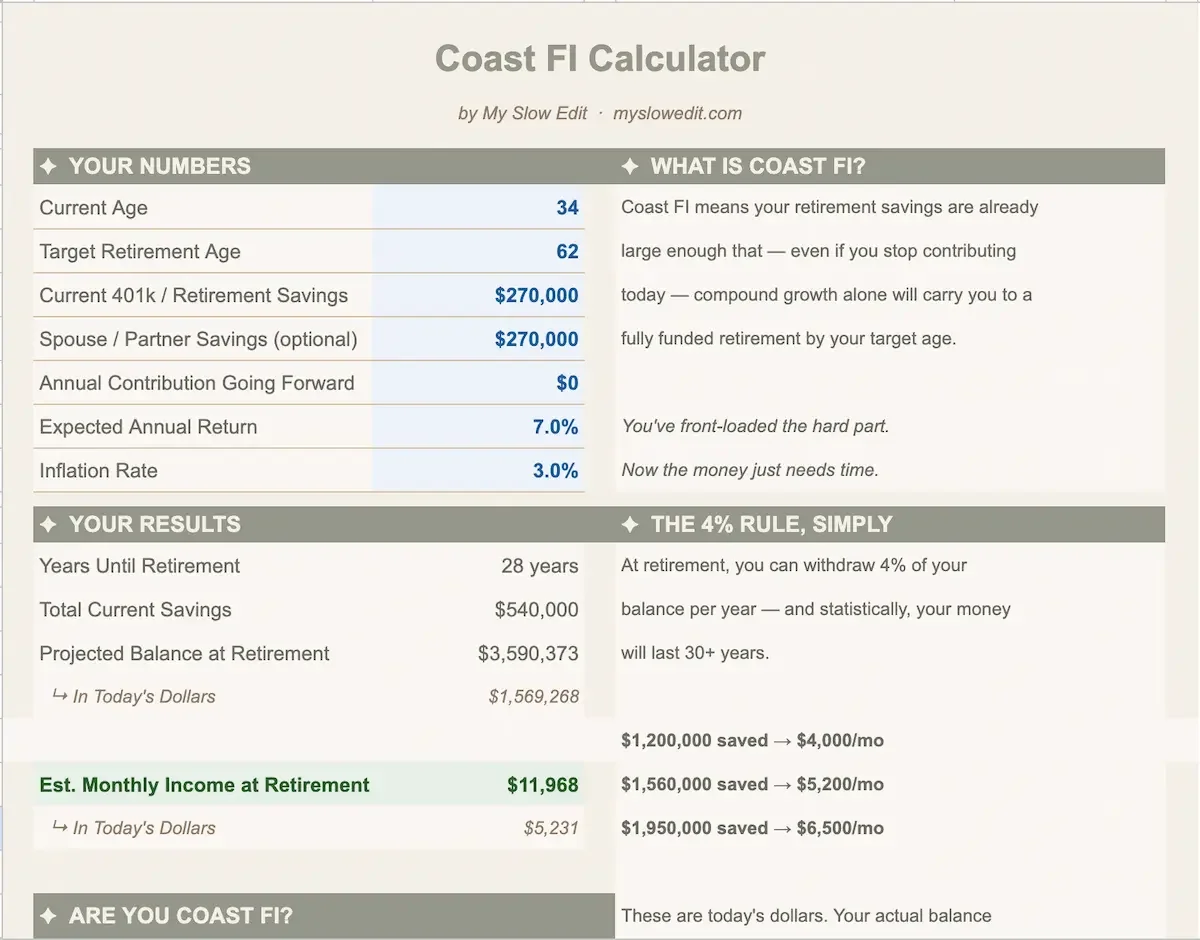
Want to run your own numbers? Grab the free Coast FI calculator I built in Google Sheets → (link in the video description — just make a copy and plug in your numbers)
My Actual Numbers
My husband and I each have about $270K in our 401ks — roughly $540K combined, both at 34.
Assuming a 6–7% return (conservative, inflation-adjusted), that's projected to grow to somewhere between $1.3M and $2M in today's purchasing power by retirement — more like $3M+ in nominal dollars when you factor in inflation.
Under the 4% rule, that translates to roughly $4,000–$6,000/month in retirement income without ever touching the principal.
And we never have to add another cent to get there.
That's what Coast FI looks like in real life. Nothing glamorous. Just time doing its thing.
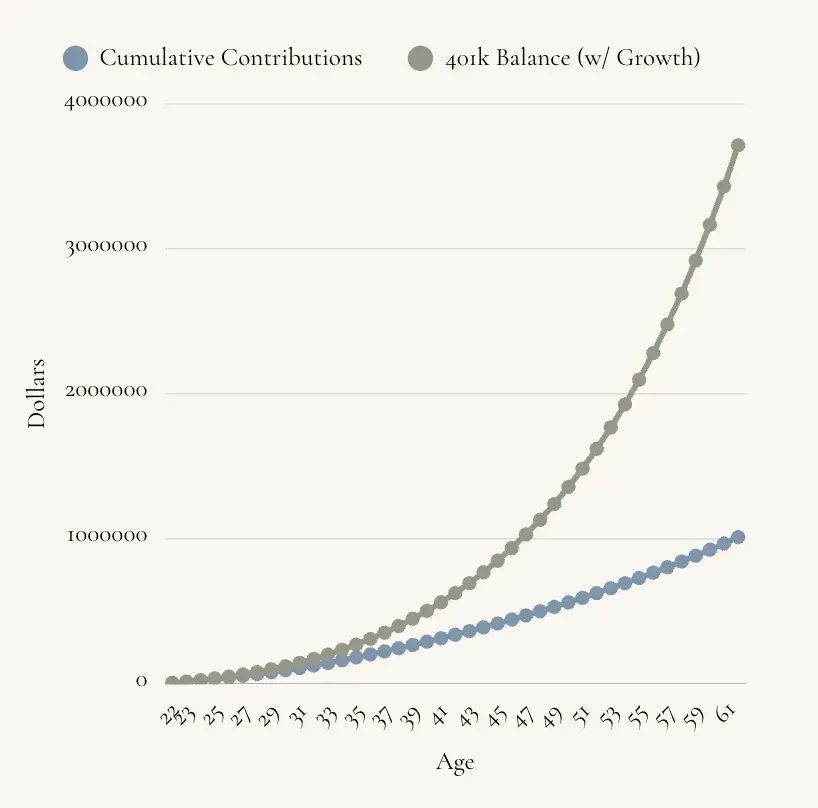
Traditional 401k example with contributions until retirement at 62.
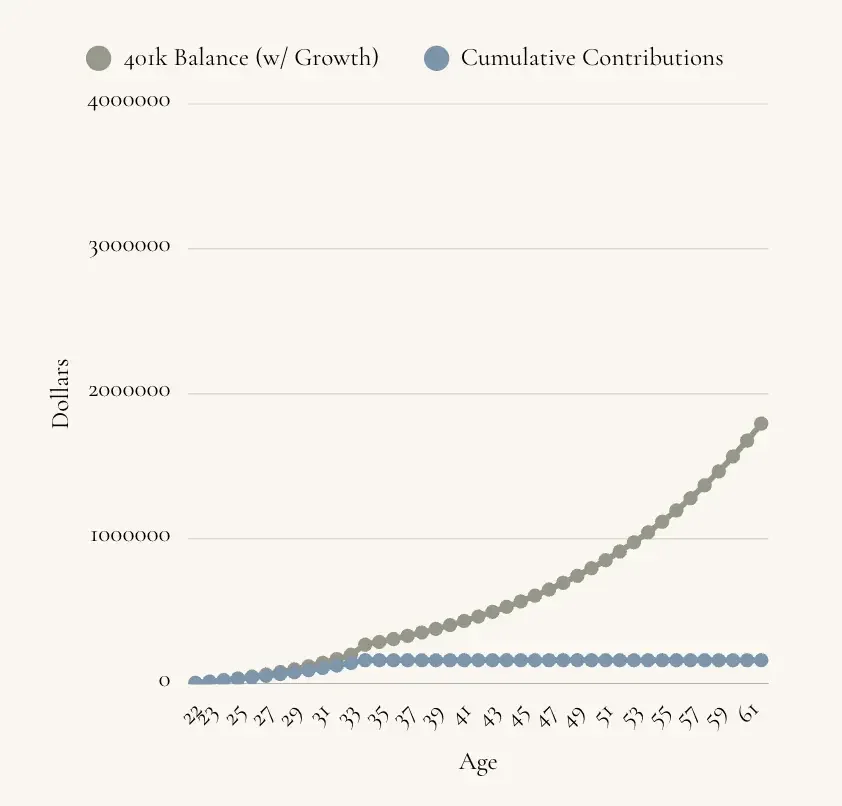
Coast Fi 401k example with contributions stopping at age 34.
How We Actually Got Here (No Strategy Required)
To be clear about what I didn't do:
No Roth backdoor conversions
No aggressive investment strategy
No optimizing beyond the employer match
No reading finance books or following a plan
I just captured the free money my employer offered, left it alone, and let compounding do the math over 12 years.
My husband did the same. Two boring 401ks. One surprisingly big number.
I'll be honest: I also made a lot of financial mistakes. Credit card debt bad enough that I did a loan consolidation. A house we probably didn't need to buy at that price point. Lifestyle creep that was very, very real. (Those get their own videos.)
The point is: this one boring habit survived my worst financial decisions and still got us here.
Why I'm Not Chasing FIRE
The natural next question is: does this mean you can retire early?
Technically, with enough savings and aggressive cuts, maybe. But that's not what I want.
FIRE — financial independence, retire early — usually means having 25x your annual expenses invested and living off 4% indefinitely. It's a real framework, but it requires either a very high savings rate or very low expenses, or both. And it often means both partners not working, which changes the math on things like health insurance significantly.
My husband has great benefits and plans to keep working. I want something different: the ability to step back from full-time corporate life, be home more with my kids, homeschool, and run a small creative business I actually enjoy. That's not retirement. It's just a different arrangement.
Coast FI gives us the foundation to start designing toward that — because at least we know retirement is handled. That pressure is off the table.
The Three-Part Plan for What Comes Next
Since retirement savings are sorted, the real question is: how do we cover our lifestyle between now and then, without my corporate income?
That's what I'm actively working on. Three things in parallel:
1. Building a buffer. An emergency fund plus invested cash savings — liquid enough to draw from monthly if needed, without touching the retirement accounts.
2. Reducing monthly expenses. Not in a punishing way, but in a meaningful way. Looking honestly at where we're spending on things that don't actually matter to us. We bought more house than we needed. There are real cuts to make.
3. Building side income I'd actually want to do. For me that's web design, content creation, and eventually digital products. Nothing that replaces a corporate salary overnight — but enough to chip away at the gap.
None of these alone gets me there. All three together might.
Where Are You on the Coast FI Spectrum?
Here's my invitation: go run your numbers.
Pull up your current 401k or retirement balance. Pick a retirement age. Assume a growth rate somewhere between 5–9% (I'd suggest running it at 6% to be conservative and 8% to see the upside). Then check what the 4% rule says about monthly income.
You might be further along than you think. I was.
→ Grab the free Coast FI calculator here — plug in your numbers and see your range